
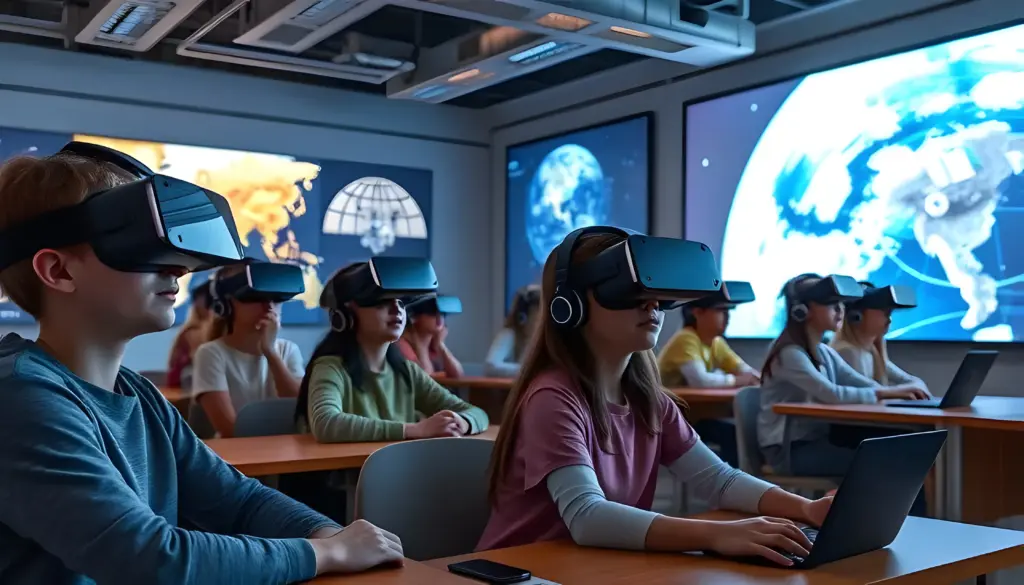
Education is entering a new era with immersive learning VR, a technology that transforms traditional classrooms into interactive, experiential environments. By combining virtual reality with multisensory stimuli, students can explore concepts, practice skills, and engage with content in ways that were previously impossible.
In this article, Olorama examines how immersive learning VR in education is evolving, the benefits for students and educators, and how technologies like scent integration are making VR experiences truly transformative. Keep reading!

Unlike conventional teaching methods, immersive learning VR in education places students at the center of the experience. Learners aren’t just observing, they are interacting with 3D environments, conducting simulations, and solving problems in real time. This hands-on approach enhances understanding, encourages exploration, and builds practical skills that extend beyond the classroom.
The versatility of immersive learning VR allows it to enhance a variety of educational settings:
By using VR, educators can provide interactive, memorable experiences that traditional classrooms often cannot achieve.
The shift from traditional teaching to immersive learning VR offers students a more engaging, interactive, and hands-on approach to education. VR transforms how knowledge is absorbed, practiced, and retained, unlocking a range of benefits that enhance both understanding and motivation:
This combination of interactivity, adaptability, and safety makes immersive learning VR technology a powerful educational tool.
While VR is often associated with visual and auditory immersion, engaging additional senses can significantly enhance learning outcomes. Olorama’s scent-generation software allows students to experience smells within virtual environments, transforming immersive learning VR into a fully multisensory experience that strengthens memory, emotional engagement, and practical understanding.
Despite these advantages, implementing immersive technology in education requires careful planning, including managing hardware and software costs, providing teacher training for effective VR lesson design, addressing potential motion sickness or screen fatigue for students, and ensuring curriculum alignment and content quality.
As VR technology continues to become more accessible and user-friendly, however, these challenges are increasingly manageable, making multisensory immersive learning a practical and impactful option for modern classrooms.
The next generation of immersive learning VR promises connected, intelligent, and fully multisensory educational experiences:
This evolution points to a future where VR is not just a teaching tool but a fundamental part of educational design.
Immersive learning VR is transforming education by creating interactive, engaging, and multisensory learning experiences. For educators and institutions looking to stay ahead, adopting immersive learning technology is a strategic move toward a future-ready, experiential learning environment.
Want to know more information? Contact us!
By placing students at the center of interactive 3D environments, VR encourages active participation and focus, making lessons more engaging than traditional methods.
Yes. It is versatile enough for STEM, humanities, vocational training, and special education, adapting content to each subject’s needs.
No. Most VR platforms are intuitive, and students quickly adapt while exploring simulations and interactive lessons.
VR provides risk-free environments where learners can experiment, practice skills, and learn from mistakes without real-world consequences.
Unlike standard online courses, VR offers presence, interactivity, and multisensory experiences that allow students to experience rather than just observe content.
Absolutely. VR can create controlled, customizable environments tailored to sensory sensitivities, attention challenges, or learning differences.
Adding smell and other sensory cues strengthens memory, emotional engagement, and practical understanding, making lessons more immersive and memorable.
While initial hardware and content can be costly, cloud-based platforms, scalable solutions, and decreasing device prices make immersive learning increasingly accessible.