
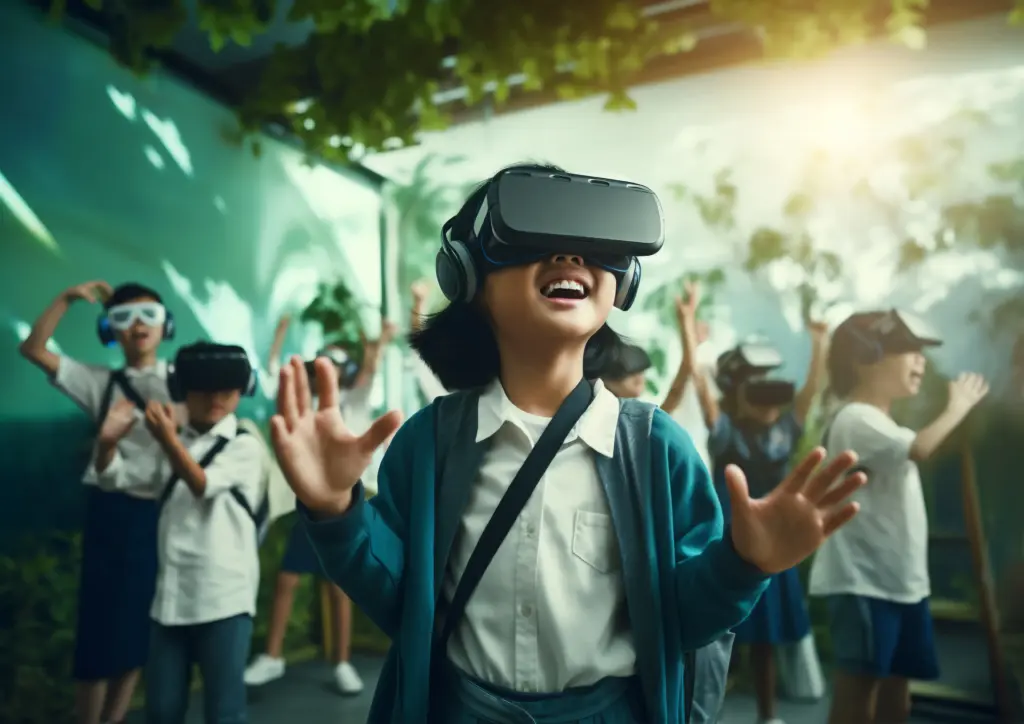
The concept of the VR classroom is rapidly evolving from an experimental innovation into a transformative force in modern education. As schools seek more immersive, engaging, and effective learning environments, virtual reality (VR) is redefining how knowledge is delivered, experienced, and retained. But what does the future truly hold for schools embracing this technology?
In this article, from Olorama, we explore the evolution of the VR classroom, the impact on students in VR environments, and how emerging technologies are shaping the next generation of education. Keep reading!

A VR classroom is a digitally simulated environment where students and teachers interact using immersive technologies such as head-mounted displays and spatial audio. Unlike traditional e-learning, VR creates a sense of presence, allowing students to experience content rather than simply observe it.
The adoption of virtual reality classroom solutions is driven by several factors:
As these technologies mature, VR is moving beyond novelty and becoming a core educational tool.
The role of students in VR environments is fundamentally different from traditional classrooms. Instead of passively receiving information, learners become active participants.
This shift from observation to experience unlocks a range of educational advantages, enhancing understanding, motivation, and skill development in ways that traditional classrooms cannot match.
Students can explore historical events, conduct virtual science experiments, or travel through the human body, experiences that would be impossible in a physical classroom. By actively participating in simulations, students gain a deeper understanding of complex concepts, retain knowledge longer, and develop critical thinking skills.
Immersion in a VR classroom reduces distractions and enhances focus, leading to higher retention rates. Students are more motivated to complete tasks when they feel “inside” the learning environment. Features such as interactive elements, gamified challenges, and real-time feedback keep learners actively involved.
VR classroom systems can adapt to individual learning speeds and styles, offering tailored educational experiences that meet the unique needs of each student. For example, a learner struggling with a math concept can repeat a simulation at their own pace, while advanced students can explore more challenging scenarios.
VR classroom allow students to practice skills in controlled, risk-free environments. Mistakes in these simulations carry no real-world consequences, giving learners the freedom to experiment and build confidence.
Educators are increasingly exploring using VR classroom across a wide range of subjects, leveraging immersive technology to enhance both understanding and engagement.
In STEM education, students can participate in virtual labs for chemistry and physics, run engineering simulations, or visualize complex mathematical concepts in 3D, offering hands-on experiences that would be difficult or impossible in traditional settings.
In the humanities and social sciences, VR enables virtual field trips to historical sites, cultural immersion experiences, and interactive storytelling, bringing abstract lessons to life. Vocational training benefits from realistic simulations of medical procedures, industrial operations, and emergency response scenarios, allowing learners to practice critical skills safely.
Additionally, VR classroom supports special education by creating controlled environments for students with sensory sensitivities and providing opportunities to develop social skills through guided role-playing experiences.
A critical question remains: how can VR be used in education to go beyond visual and auditory immersion? The answer lies in multisensory learning.
While most VR classrooms rely on sight and sound, research shows that engaging additional senses significantly enhances memory and emotional connection. This is where innovative technologies such as Olorama’s scent-generation software come into play.
Olorama enables the integration of olfactory stimuli into virtual environments, allowing students to smell what they see.
Examples of multisensory learning with Olorama:
By incorporating scent, the VR classroom becomes a fully immersive learning space that enhances cognitive recall and emotional engagement.
Despite its potential, implementing a virtual reality classroom comes with challenges:
However, as technology advances and costs decrease, these barriers are gradually diminishing.
The future of the VR classroom promises far more than immersive visuals and interactive experiences, it is set to become intelligent, connected, and fully multisensory. Emerging trends suggest a classroom where every learner experiences personalized pathways, collaborative opportunities with peers worldwide, and engagement that extends beyond sight and sound, tapping into multiple senses for deeper understanding and retention.
Adaptive VR systems will dynamically tailor content in real time based on individual student performance, learning speed, and preferences. This personalization allows educators to provide targeted challenges for advanced learners while offering additional support where needed, ensuring that each student reaches their full potential.
Cloud-based solutions are reducing the dependency on expensive hardware, enabling schools to scale access to VR experiences more easily. Students can log into virtual classrooms from multiple devices, collaborate remotely, and access resources instantly.
While most VR experiences focus on sight and sound, the next generation of classrooms will integrate multiple senses to create fully immersive learning environments. Technologies like Olorama’s scent-generation software enable students to smell, touch, and even experience environmental cues within VR simulations.
VR will break down geographical barriers, allowing students from different parts of the world to collaborate in shared virtual spaces. Global classrooms can foster cross-cultural understanding, collaborative problem-solving, and exposure to diverse perspectives, all within immersive, interactive learning environments.
By tracking interactions, performance, and engagement in VR environments, educators can gain powerful insights into student behavior and learning patterns. This data can inform instructional strategies, identify knowledge gaps early, and measure the effectiveness of teaching methods.
The VR classroom represents a paradigm shift in education. By combining immersive technology with innovative solutions like Olorama’s scent-generation software, schools can create deeply engaging, effective, and memorable learning experiences.
As educators continue using VR in the classroom, and as more institutions explore how VR can be used in education, one thing is clear: the future of learning is not just digital, it is experiential and multisensory.
For schools looking to stay ahead, investing in VR classroom is no longer optional, it is a strategic step toward the next generation of education. Contact us!
VR enhances engagement and retention, helping students understand complex concepts faster than traditional methods.
K-12, higher education, vocational training, and special education programs can all leverage VR effectively.
Not completely. VR complements real-world experiences but cannot fully replace hands-on interaction.
It provides controlled, customizable environments and paced learning to suit individual needs.
Head-mounted displays, compatible devices, VR content, and optionally multisensory tools like Olorama.
Yes, secure platforms use encryption and comply with educational data privacy standards.
AI personalization, multisensory integration, haptic feedback, and cloud-based VR will make learning more immersive.