
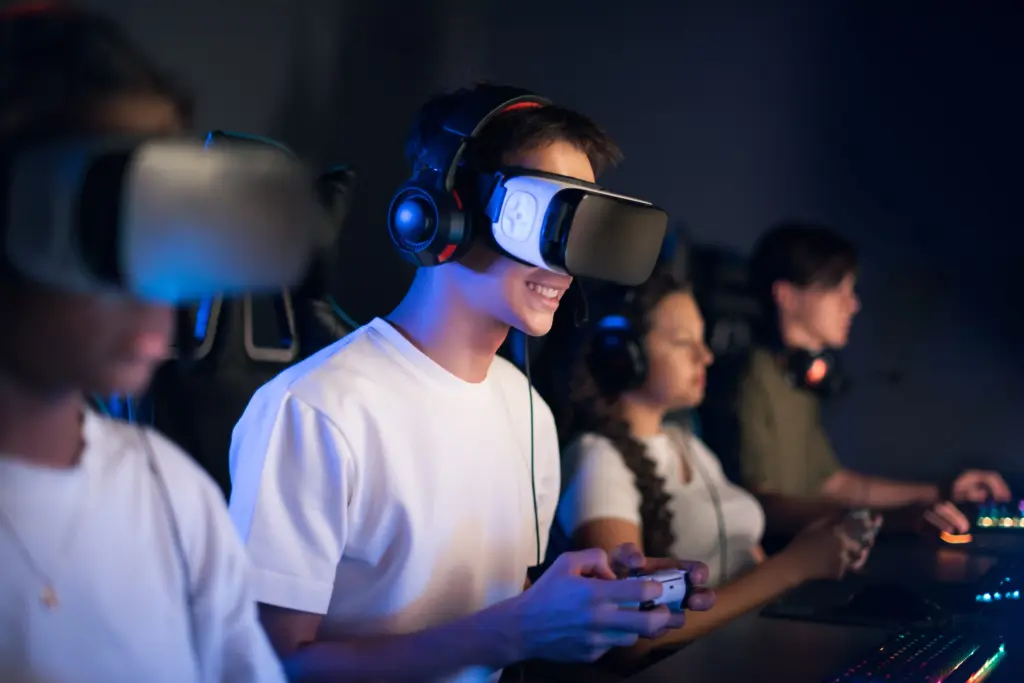
Interactive entertainment is evolving beyond screens, speakers and traditional interfaces. As audiences become increasingly familiar with high-resolution graphics, spatial audio, virtual reality and responsive environments, entertainment creators are looking for new ways to make digital experiences feel more tangible.
One of the most promising developments is the integration of scent. By combining sight, sound and smell, interactive entertainment can engage multiple senses simultaneously, creating experiences that feel more immersive, memorable and emotionally engaging.
At the forefront of this evolution is Olorama, a professional digital scent technology designed to synchronize realistic aromas with interactive and audiovisual content. Keep reading!

Interactive entertainment refers to experiences in which audiences actively participate in, influence or respond to the content around them. Unlike traditional media, where viewers primarily observe, interactive experiences can react to decisions, movements, voice commands, touch or other forms of interaction.
Video games are one of the most established examples. However, the concept now extends to:
These environments increasingly combine different sensory channels to create a stronger sense of presence. Visuals establish the world. Sound gives it atmosphere and movement. Scent adds another layer of physical realism.
Immersive experiences are built by bringing different sensory elements together and making them work as one. Sight creates the visual world, sound gives it depth and emotion, while scent adds a tangible layer that can make digital environments feel remarkably real. Let’s explore how each of these senses contributes to creating more engaging and memorable interactive entertainment experiences.
Vision remains the foundation of most interactive entertainment experiences.
High-resolution displays, 3D graphics, projection mapping and virtual reality allow creators to construct increasingly detailed environments. A player can explore a forest, walk through a futuristic city or enter an imaginary world without physically travelling anywhere.
For interactive entertainment games, visual information also communicates essential gameplay elements: environments, characters, objects, hazards and narrative cues. But visual realism alone does not necessarily make an experience feel real.
A digital forest may look incredibly convincing, but there is a fundamental sensory gap between seeing a forest and feeling as though you are actually surrounded by one. This is where additional sensory channels become valuable.
Sound design gives visual environments depth.
A game can use footsteps, wind, rain, music, voices and environmental effects to communicate what is happening outside the player’s field of vision. Spatial audio can make sounds appear to originate from specific directions, strengthening the perception of being physically present inside an environment.
For example, imagine entering a virtual rainforest. You can see dense vegetation and hear birds, insects and distant thunder. The combination already creates a convincing audiovisual environment.
Now imagine that the experience also introduces the smell of wet vegetation and earth. The experience changes. The environment is no longer represented exclusively through pixels and audio. The brain receives an additional sensory cue associated with the physical world.
Smell is one of the least explored senses in digital entertainment, but it can be a powerful component of multisensory experience.
Unlike visual and auditory information, scent does not need to describe an environment. Instead, it can provide an immediate sensory association with it.
A burning smell can reinforce the presence of fire. A forest aroma can complement a virtual woodland. Food aromas can strengthen a culinary scene. Ocean or rain-inspired scents can add realism to an environmental simulation.
This makes scent particularly interesting for interactive entertainment games, where aromas can be connected to specific actions, locations or events.
The key difference between conventional scent marketing and interactive scent technology is timing and control.
An ambient fragrance can make a space smell pleasant, but an interactive scent system can deliver an aroma as part of the experience itself.
For example:
Player enters a forest, visual environment changes, environmental sounds begin and forest scent is released.
Or:
Virtual fire appears, sound intensifies and burning aroma is activated.
The scent becomes an interactive element rather than simply background fragrance. This synchronization can be particularly powerful because the audience does not just smell something randomly. The aroma has a narrative or experiential purpose.
Olorama’s digital scent technology is designed specifically to integrate olfactory stimulation into professional interactive and immersive environments.
The system uses professional scent synthesizers capable of integrating up to 10 realistic scents per device. These scents can be activated through different control systems, including API, DMX, applications with speech recognition, Unity and Unreal Engine. Multiple synthesizers can also be combined when a project requires additional scents.
This software integration is particularly relevant to interactive entertainment. Instead of treating scent as an independent element, developers can connect an aroma to an event inside the experience. For example:
Olorama specifically positions its technology for interactive smells, including interactive kiosks, touchscreens, digital signage, sensory stimulation and scented games.
The evolution of interactive entertainment is moving toward increasingly multisensory experiences.
Graphics will continue to improve. Spatial audio will become more sophisticated. Haptic technologies will provide increasingly detailed physical feedback. And scent has the potential to become another essential layer. For developers and experience designers, this means thinking beyond the screen.
The next generation of interactive entertainment games and immersive experiences may not simply ask users to look, listen and interact. They may allow audiences to experience virtual environments through a much broader sensory spectrum.
Olorama demonstrates how professional digital scent technology can become part of that ecosystem. With realistic aromas, rapid diffusion, scalable hardware and software-based activation through technologies such as Unity and Unreal, scent can be integrated into the architecture of an interactive experience rather than added as an afterthought.
Want to know more about? Contact us!